
Black tinted mirrors (often specified in architectural blueprints as dark smoked or obsidian mirrors) are a hallmark of contemporary luxury interior design, executive hospitality suites, and high-end elevator lobbies. Unlike conventional bathroom mirrors that reflect scene luminance with pure silver fidelity, a black tinted mirror texture combines high-gloss specular reflectivity with deep, mood-defining volumetric absorption. Yet, 3D artists frequently botch this material in Blender, Unreal Engine 5, or V-Ray. The classic mistake: turning Base Color to pitch black (#000000) and pushing Metallic to 1.0. The result looks like cheap polished black plastic or oily chrome, completely lacking the optical depth of genuine tinted architectural glass.
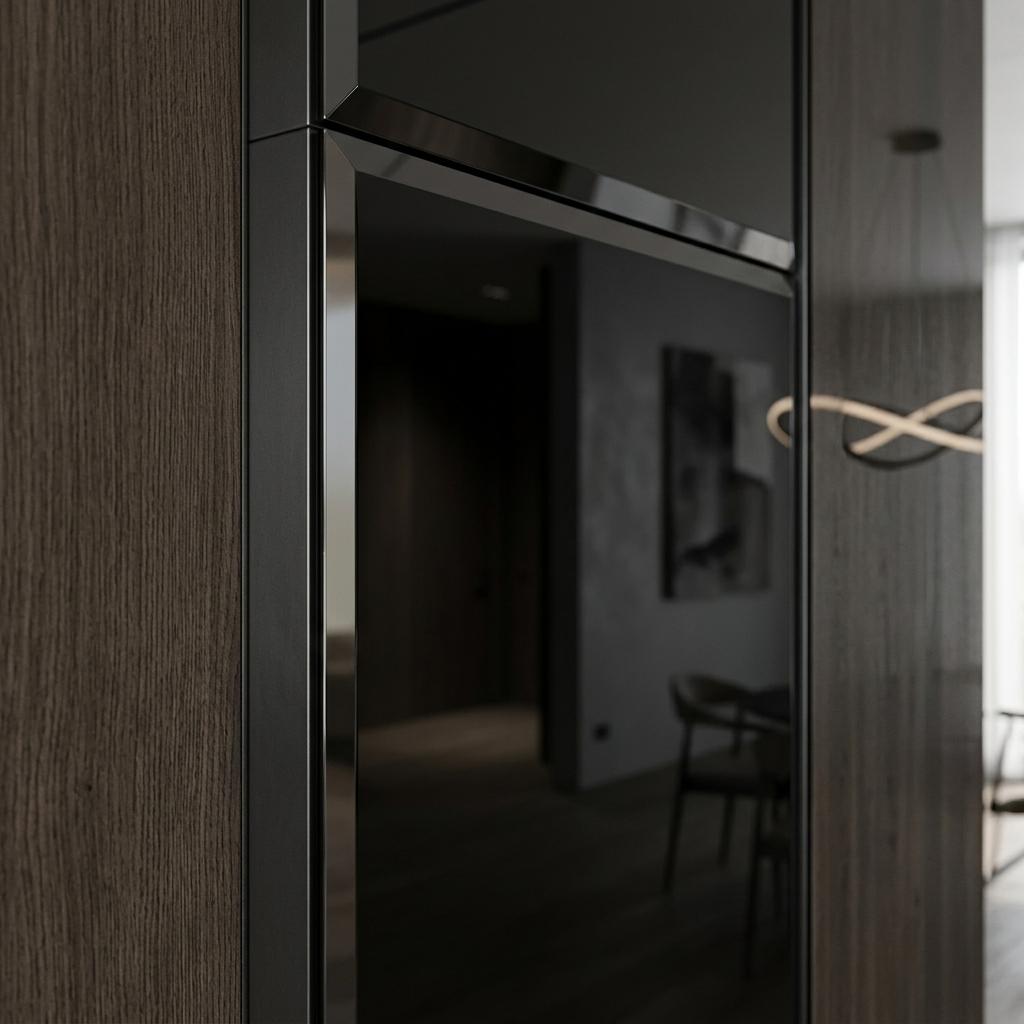
A photorealistic black tinted mirror relies on dual-interface optical behavior: front dielectric glass reflection combined with internal volumetric tint absorption over a silvered backing.
In physical manufacturing, a black tinted mirror is produced by pouring a silvering compound onto the back of dark body-tinted float glass. Understanding how light transmits through tinted dielectric float glass before striking the reflective metallic substrate is essential for building believable PBR shaders. Below is the production workflow for calibrating physical absorption, authoring edge chamfer normal maps, and rendering black tinted mirrors across architectural scenes.
Physical Stratification of Tinted Glass Mirrors
To build a physically accurate shader, break down the physical layers of an architectural smoked mirror:
[Black Tinted Mirror Optical Layering]
Incident Ray ──> [Front Glass Boundary (Air/Glass IOR 1.52)] ──> 4% Fresnel Specular Reflection
                      │
                      ▼ (Transmitted Light)
                 [Tinted Float Glass Substrate (3mm - 6mm Body Tint)] ──> Volumetric Light Absorption
                      │
                      ▼
[Silver / Aluminum Nitrate Backing] ──> Total Metallic Reflection (Ray returns through glass)- Front Surface Dielectric Interface: Incident light first hits the clear or lightly tinted front face of the float glass. Governed by Fresnel equations at an Index of Refraction (
IOR 1.50 - 1.54), approximately 4% to 5% of light reflects directly at normal incidence, increasing to 100% glancing reflection at grazing angles. - Body Tint Volumetric Absorption: The light that penetrates the glass travels through 3mm to 6mm of glass containing dissolved metal oxide colorants. According to the Beer-Lambert law, light loses intensity exponentially based on path length. In a black tinted mirror, shorter and longer wavelengths are absorbed relatively uniformly, attenuating overall transmission down to 15% to 30%.
- Silvered Metallic Substrate: Rays that survive transmission hit the rear chemical silvering layer (
Metallic 1.0), reflecting backward through the tinted glass body a second time. This double-pass absorption gives black mirrors their signature rich, ink-like reflection depth. - Beveled Edge Chamfers: Architectural wall mirrors are rarely cut with razor-sharp 90-degree polygon borders. Edges feature a
1.5mmto4.0mmpolished chamfer. Capturing this transition in a baked or procedural normal map catches striking specular rim glints that ground the panel in the 3D scene.
PBR Black Tinted Mirror Calibration Matrix
Use this physical parameter reference matrix to calibrate your shaders across primary architectural smoked mirror styles:
| Tinted Mirror Variety | Base Color (RGB Hex) | Metallic | Specular IOR | Roughness Range | Normal Map Profile | Transmission / Absorption |
|---|---|---|---|---|---|---|
| Obsidian Dark Smoked (Clean) | #121314 (Deep obsidian) | 0.85 - 0.95 | 1.520 | 0.015 - 0.035 | Micro wiper streaks, edge bevel | Volumetric density 0.8 |
| Warm Espresso Smoked Mirror | #1C1815 (Dark chocolate) | 0.80 - 0.90 | 1.515 | 0.020 - 0.045 | Faint polishing swirl normal | Warm brown absorption |
| Satin Frosted Black Mirror | #202224 (Neutral charcoal) | 0.40 - 0.60 | 1.520 | 0.300 - 0.480 | Fine acid-etched isotropic noise | Frosted surface scatter |
| Fluted Reeded Black Mirror | #161718 (Smoked graphite) | 0.85 - 0.92 | 1.525 | 0.020 - 0.050 | Cylindrical vertical rib wave | Deep ribbed refraction |
| Antique Desilvered Black Mirror | #242526 (Aged slate) | 0.50 - 0.75 | 1.510 | 0.080 - 0.250 | Irregular foxing pit normal | Localized backing oxidation |
Note: For single-surface game-engine shaders where true volumetric transmission is too expensive, setting Metallic between 0.85 and 0.92 with Base Color at #121314 accurately approximates the dark specular absorption of real smoked mirrors without doubling draw call overhead.
Step-by-Step: Setting Up a Black Tinted Mirror in Blender and UE5
Follow this production workflow to author a realistic black tinted mirror shader:
-
Model Edge Chamfers or Bake Bevel Normals: In Blender, add a
1.5mmbevel modifier to your mirror geometry, or insert a Bevel shader node in Cycles (Radius: 0.002m) feeding into the normal vector pipeline. In Unreal Engine 5, bake high-poly chamfered edges into a tangent-space normal map to avoid expensive geometry on modular wall assets. -
Configure Dual-Lobe Reflection (Blender Cycles):
- For an architectural visualization render, create a multi-layer node setup:
- Use a Glass BSDF (Color:
#252627, IOR:1.52, Roughness:0.02). - Place an internal plane directly behind the glass with an Anisotropic / Principled BSDF set to
Metallic: 1.0andRoughness: 0.01.
- Use a Glass BSDF (Color:
- For single-shader optimization: Set Principled BSDF with
Base Color: #141516,Metallic: 0.88,Roughness: 0.025, andIOR: 1.52.
- For an architectural visualization render, create a multi-layer node setup:
-
Inject Realistic Surface Imperfections: A mathematically clean mirror looks fake. Sample a subtle surface imperfection roughness map (clean microfiber wiping streaks) and remap its output between
0.02(polished center) and0.06(slight cleaning haze). Keep variations gentle; heavy fingerprints ruin the luxury feel of architectural mirrors. -
Blend Float Glass Roller Waves into the Normal Socket: Float glass cooling creates micro-waves with long wavelengths (
30cmto60cm). Add a procedural Perlin normal with ultra-low amplitude (Strength: 0.02 – 0.04) to gently curve reflected skyline horizons.
[Blender 4.x Optimized Black Tinted Mirror Node Setup]
(Base Color: #141516) ─────────────> [Principled BSDF: Base Color]
(Microfiber Map) ──[Map Range: 0.02 - 0.06] ──> [Principled BSDF: Roughness]
(Metallic: 0.88) ──────────────────> [Principled BSDF: Metallic]
(IOR: 1.52) ───────────────────────> [Principled BSDF: IOR]
(Perlin Float Wave Normal) ──[RNM]─> [Principled BSDF: Normal]
(Bevel Node: 2mm Radius) ───┘- Configure Unreal Engine 5 Lumen Reflections:
When rendering smoked mirrors in Unreal Engine 5 with Lumen:
- In your Post Process Volume, set Lumen Reflections Quality to
2.0or higher to eliminate low-resolution screen-space reflection ghosting. - For interior spaces with bright chandeliers, enable Hit Lighting for Reflections to ensure specular highlights bounce realistically off the dark mirror pane.
- In your Post Process Volume, set Lumen Reflections Quality to
Creating Custom Tinted Mirror Textures and Normal Maps
Sourcing specialized seamless black tinted mirror textures with bespoke edge chamfer normals, subtle cleaning wipes, and custom fluted glass profiles from static asset sites is frustrating. AI-assisted texture generators produce calibrated roughness maps and normalized vector fields tailored to exact interior dimensions.
If you need to generate production-ready tinted mirror normal maps, surface imperfection masks, and luxury PBR glass sets, power up your ArchViz pipeline with our Free Online Normal Map and PBR Generator — Try Black Tinted Mirror. You can also generate seamless tileable smoked mirror wall surfaces for large commercial interiors using our Seamless Texture Generator Online.
Black Tinted Mirror Production Checklist
- Base Color dialed to dark obsidian tone (
#121314to#18191A), avoiding unphysical pure black#000000. - Single-shader approximation utilizes calibrated
Metallic: 0.85 - 0.92to simulate internal silver backing. - Polished edge chamfers captured via
1.5mm - 3.0mmbevel normal maps. - Float glass waviness kept subtle (
Normal Strength: 0.02 - 0.04) to prevent funhouse mirror warping. - Surface roughness clamped between
0.015and0.060to preserve mirror clarity while breaking CG perfection. - Post-process reflections calibrated in UE5/Lumen to resolve fine specular details.
Related reading: Bronze Mirror Texture Seamless · Brown Mirror Texture Seamless · Window Normal Map Guide · Grey Lacquer Texture PBR Guide