
Textile shading is notoriously tricky in 3D character art, digital fashion design, and architectural upholstery. Flat cotton and polyester fabrics can often get away with standard 2D diffuse bitmaps and modest normal maps. But when you tackle heavy knitwear — specifically a handcrafted crochet vertical texture — the standard shading workflow breaks down completely. If you render a vertical ribbed crochet sweater with a generic fabric shader, the thick wool loops flatten into painted cardboard, the stitch crevices look muddy, and the fabric loses the characteristic fuzzy specular halo that makes knitwear look soft to the touch.
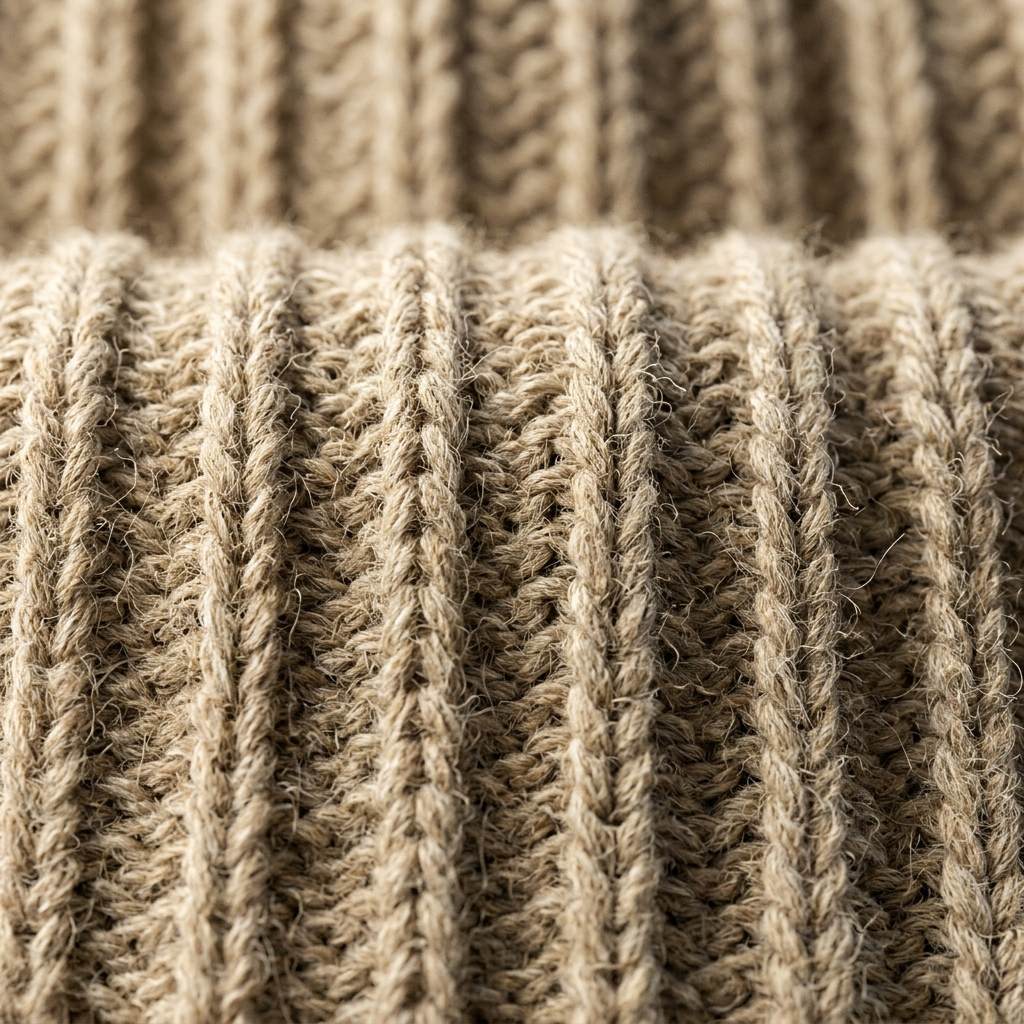
Authentic vertical crochet textures combine deep alternating rib valleys, twisted yarn ply normal maps, and grazing-angle sheen fuzz scattering.
A true vertical crochet rib (frequently constructed using front-post double crochet or single crochet back-loop-only stitches) is a three-dimensional sculptural relief. Thick plied yarns twist over each other, creating pronounced interlocking ridges separated by deep structural valleys. Below is the comprehensive technical pipeline for capturing stitch depth, configuring PBR sheen and fuzz shaders, and authoring vertical crochet textures in Blender and Unreal Engine 5.
The Tri-Tier Frequency Stack of Crochet Textiles
Believable 3D knitwear requires isolating three distinct spatial frequency bands before routing normal and displacement vectors into your shader:
[Tri-Tier Frequency Architecture for Crochet]
Macro Tier: Structural rib columns and cable valleys (8mm - 16mm period) ──┐
                                                                           ├──> [RNM Blend] ──> [Final Normal Map]
Meso Tier: Twisted multi-ply yarn cord twists (1.5mm - 3.0mm period)      ──┤
                                                                           │
Micro Tier: Airborne fiber halo and spun wool barb noise (0.1mm - 0.3mm) ──┘- Macro Frequency (Rib Columns and Valley Seams): The structural columns of crochet stitches produce deep undulating relief. In a standard single-crochet rib, the peak-to-trough distance measures between
3mmand6mmin real-world thickness. Capturing this macro contour in a height/displacement map allows parallax occlusion mapping (POM) to cast self-shadows between neighboring ribs. - Meso Frequency (Yarn Ply Helixes): Knitting and crochet yarns are made by spinning multiple strands (plies) together in an S-twist or Z-twist helical spiral. Each individual crochet loop showcases angled twist bands. Without this meso normal detail, the ridges look like extruded plastic tubes rather than spun textile threads.
- Micro Frequency (Fiber Nap and Wool Halo): Fine flyaway hairs, loose wool barbs, and electrostatic fuzz create a microscopic perimeter halo. This layer scatters grazing-angle light diffusely, creating the soft specular sheen characteristic of natural animal fibers.
PBR Crochet and Knitwear Parameter Calibration Table
Different yarn fibers and stitch tensions exhibit radically different reflectance, sheen, and porosity behaviors. Use this reference matrix to configure your textile PBR shaders:
| Crochet Textile Variety | Base Color (RGB Hex) | Roughness Range | Sheen / Fuzz Weight | Subsurface Scatter (SSS) | Normal Map Profile | Micro Displacement Depth |
|---|---|---|---|---|---|---|
| Chunky Wool Vertical Rib | #C2B49A (Warm oatmeal) | 0.85 - 0.98 | 0.70 - 0.95 | 0.15 (Warm peach radius) | Deep V-ridge valley with ply spiral | 4.0mm - 6.0mm |
| Mercerized Cotton Cable | #3A4B5C (Indigo navy) | 0.55 - 0.75 | 0.20 - 0.40 | 0.05 | Smooth, crisp twisted cord loops | 2.5mm - 4.0mm |
| Mohair Openwork Crochet | #E8DCD4 (Soft blush) | 0.92 - 1.00 | 0.90 - 1.00 | 0.30 (Luminous diffuse) | Faint porous lattice with wild fuzz | 1.5mm - 3.0mm |
| Acrylic Chunky Blanket | #D47055 (Terracotta) | 0.70 - 0.88 | 0.35 - 0.55 | 0.08 | Uniform machine-embossed ridges | 3.0mm - 5.0mm |
| Alpaca Blend Ribbed Knit | #584B42 (Deep taupe) | 0.88 - 0.98 | 0.80 - 0.95 | 0.22 | Soft organic fiber nap and pill nodules | 3.5mm - 5.5mm |
Note: Natural textiles are absolute dielectric insulators. Metallic must remain strictly 0.0. Metallic lurex accent threads should be isolated using a dedicated binary metallic mask on a separate shader layer.
Step-by-Step: Setting Up a Realistic Cloth Shader in Blender and UE5
Follow this production workflow to build a tactile vertical crochet shader:
-
Align UV Layout with Stitch Direction: Ensure garment UV islands are laid out strictly along the vertical axis (Y / V coordinate). Vertical crochet ribs must run parallel to physical seams; diagonal UV shearing immediately betrays synthetic 3D mapping.
-
Configure the Sheen / Cloth Shading Model:
- In Blender 4.x Principled BSDF:
- Set Sheen Weight to
0.85. - Set Sheen Tint to match the lighter highlight tones of your Base Color.
- Set Sheen Roughness to
0.40to wrap grazing-angle specular scatter around curved yarn silhouettes.
- Set Sheen Weight to
- In Unreal Engine 5:
- Switch Material Shading Model to Cloth.
- Feed a warm Fresnel mask into the Fuzz Color pin.
- Set Cloth weight to
1.0.
- In Blender 4.x Principled BSDF:
-
Blend Multi-Tier Normal Maps via RNM: Never mathematically add micro-fuzz normals directly to macro stitch ribs. Combine your macro rib normal map with your high-frequency yarn ply normal using Reoriented Normal Mapping (RNM) to preserve vector lengths and prevent darkened boundary artifacts.
[Blender 4.x Vertical Crochet Shader Architecture]
(Base Color: #C2B49A) ─────────────> [Principled BSDF: Base Color]
(Roughness: 0.92, Cavity-Tuned) ───> [Principled BSDF: Roughness]
(Metallic: 0.0) ───────────────────> [Principled BSDF: Metallic]
(Sheen Weight: 0.85) ──────────────> [Principled BSDF: Sheen Weight]
(Sheen Roughness: 0.40) ───────────> [Principled BSDF: Sheen Roughness]
(Macro Rib Normal) ──[RNM]─────────> [Principled BSDF: Normal]
(Yarn Ply Twist Normal) ──┘
(Inverted Height Map) ─────────────> [Ambient Occlusion / Cavity Multiply]-
Deepen Stitch Crevices with Ambient Occlusion: Light struggles to penetrate the tight valleys between thick crochet cords. Invert your height displacement map and run it through a high-contrast ColorRamp to generate an ambient occlusion crevice mask. Multiply this mask against Base Color (subtly, by factor
0.30 - 0.50) and use it to boost Roughness up to1.0in the deepest recesses. -
Implement Parallax Occlusion Mapping (POM): For real-time game clothing in Unreal Engine 5, flat normal maps fail when viewed at acute grazing angles. Feed your 16-bit displacement height map into a
ParallaxOcclusionMappingmaterial function with a step count between16and32. This forces the vertical ribs to physically occlude the valleys behind them as the character rotates.
Creating Custom Vertical Crochet Textures and Normal Maps
Hand-sculpting continuous vertical crochet patterns across complex garment meshes in high-poly digital sculpting suites is labor-intensive and prone to visible repeat seams along armholes and collar ribbing. Modern AI-assisted texture generators synthesize seamless tileable crochet cord patterns and calculate physically normalized height fields directly from text prompts.
If you need to generate production-ready vertical crochet normal maps, yarn displacement maps, and complete PBR fabric sets for character fashion and interior throws, power up your pipeline with our Free Online Normal Map and PBR Generator — Try Vertical Crochet Fabric. You can also generate seamless tileable knitted fabric patterns for large upholstery surfaces using our Seamless Texture Generator Online.
Vertical Crochet Production Checklist
- UV coordinates aligned strictly parallel with stitch grain to prevent diagonal pattern shearing.
- Sheen / Cloth shading model activated with grazing-angle Fresnel fuzz enabled.
-
Metalliclocked strictly to0.0; organic wool and cotton fibers are 100% dielectric. - Macro rib normal blended with meso yarn ply spiral via Reoriented Normal Mapping (RNM).
- Deep stitch crevices shaded with AO cavity masks to prevent flat interior illumination.
- Parallax Occlusion Mapping (POM) or micro displacement applied for silhouette occlusion.
Related reading: Fabric Normal Map Textile Guide · Fabric Texture Seamless Guide · Roughness Map Guide · Cloth Texture Seamless